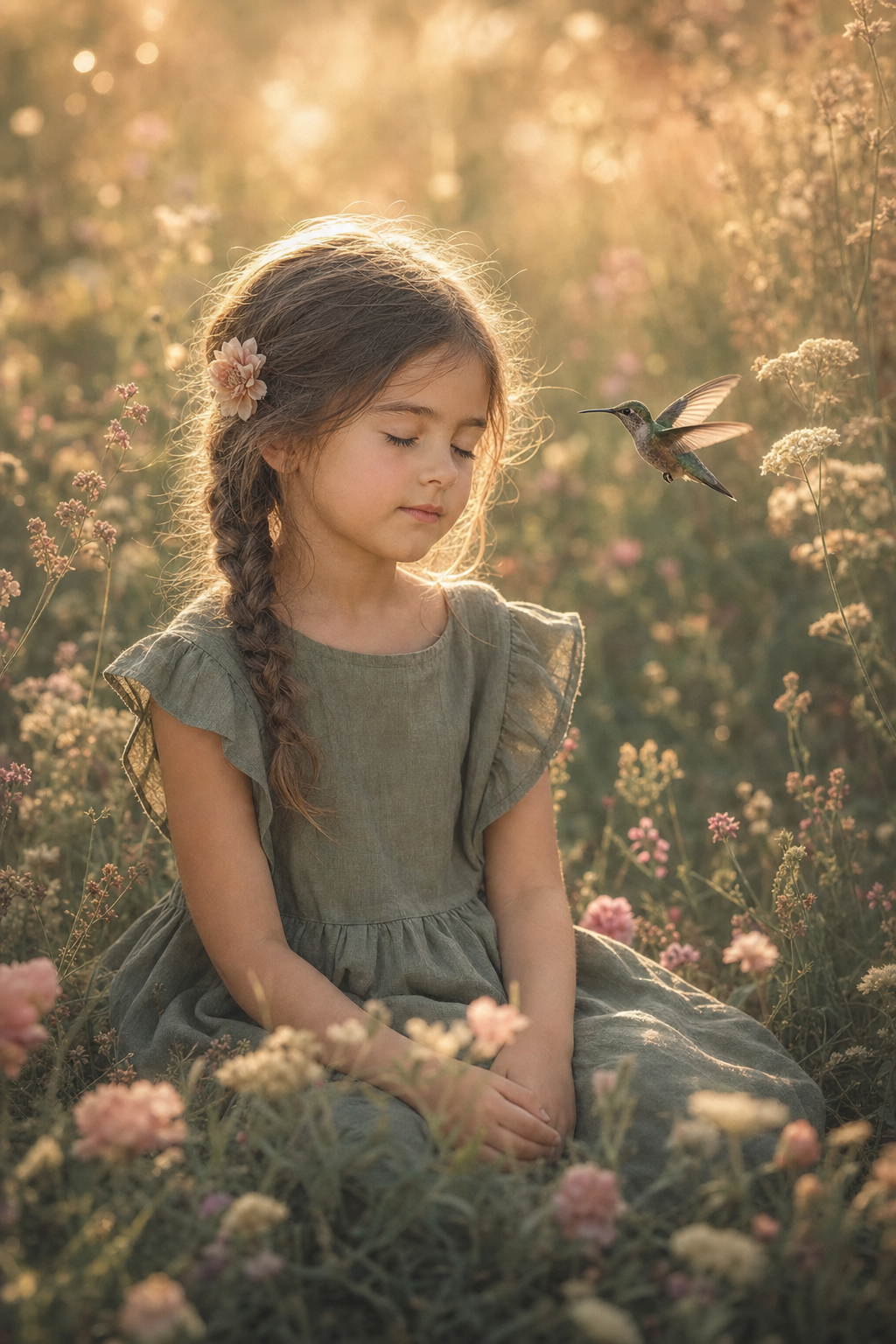
Beauty is essential
Mindfulness tools for children should be as beautiful as any other object in a thoughtfully curated home. Aesthetics are not superficial; they are the invitation.
"We believe that mindfulness for children should feel like an invitation, not a prescription."— The Hummingbird Whisper
Mindfulness is often presented as a remedy for stress or difficult emotions. We see it differently. We believe children deserve opportunities for stillness, gratitude, and self-awareness in everyday life, offered with care rather than as a correction. Like watching a hummingbird hover over a flower, mindfulness should awaken curiosity and joy, making a child want to return to it again and again.
We see mindfulness not as a trend, but as a lifelong language: a way of meeting thoughts, emotions, and the full terrain of inner life with curiosity and compassion. A language that does not demand fluency before it offers its gifts. One that grows alongside a child from the very beginning, through the big feelings of early childhood, the searching questions of the middle years, and the quiet uncertainties of adolescence.
Unlike so many tools that arrive as corrections (things designed to fix behavior, manage emotions, or achieve calm on demand), this is something different. It is not a remedy. It is a relationship. A relationship with one's own inner world that deepens with each passing year, and that ultimately teaches a child the most important thing they will ever learn: how to be with themselves.
This is why we do not speak in urgency. We design for the ordinary Tuesday: the bedtime that stretches too long, the quiet car ride when a child stares out the window and something wordless moves through them. These are the moments a living language is built inside of.
We create for families who value depth and beauty, who want their children's inner worlds to be met with the same care they bring to their outer lives. Who understand, perhaps intuitively, that the practices woven into the earliest years do not simply pass through a child. They stay. They shape. They become the quiet architecture of who that child grows into.
A hummingbird does not hover because it has been told to be still. It hovers because stillness is the very thing that allows it to receive. That is the image we return to: not a child corrected into calm, but a child who has discovered, slowly and with wonder, that there is something nourishing in the pause.
This is the language we are building together, one small practice at a time, one quiet story, one gentle breath before sleep. Not a program to complete, but a way of moving through life that a child carries long after the storybook is closed. A language that, once learned, is never forgotten.
Mindfulness tools for children should be as beautiful as any other object in a thoughtfully curated home. Aesthetics are not superficial; they are the invitation.
A single breath. A quiet pause. A kind thought. These tiny moments shape an entire day, and over time, an entire life. We honor the smallness of these practices.
We design with deep respect for the emotional intelligence that children already carry. Our role is to offer language and tools, not to prescribe or correct.
Daily ritual is one of the most powerful forces in human wellbeing. Bedtime breathing. Morning gratitude. An evening story. These small ceremonies are the architecture of a life.
Walking beside a child with intention is one of the hardest and most beautiful things a person can do. We create resources that serve the caregiver as much as the child.
Inner steadiness is not a personality trait; it is something that can be learned, practiced, and deepened over a lifetime. We give children the tools to build it from the very beginning.
Spiritual growth is woven quietly into the fabric of daily life. It is in the story read before bed, the three breaths taken before a big feeling, the whispered gratitude at the end of the day, the small pause before a choice.
They Already Know. On Trusting the Quiet Wisdom Your Child Was Born With
Your child carries a quiet wisdom that grows as you listen together. Give it room, like sunlight streaming through an open window.
Read this post Conscious Parenting — BlogNo Feeling Too Big. How Emotional Literacy Opens Doors for Your Child
“There is no feeling too big for us to hold together.” What Bella always knew, and how naming feelings gives children the language and the permission to know themselves.
Read this postAnd the adults who want to walk beside them with intention.